
SaaS companies must commit to boosting their customer experience to survive. A personalized customer experience is difficult to achieve for multiple reasons. Companies must change how they think about customer experience, then redesign their organizations, policies, GTM strategies, and customer acquisition processes. Furthermore, this transition requires a strong understanding of the customer lifecycle, buying process, customer journeys, customer demographics, and behavioral data.
In this chapter, we cover six essential steps for evolving to become an experience-centric organization:
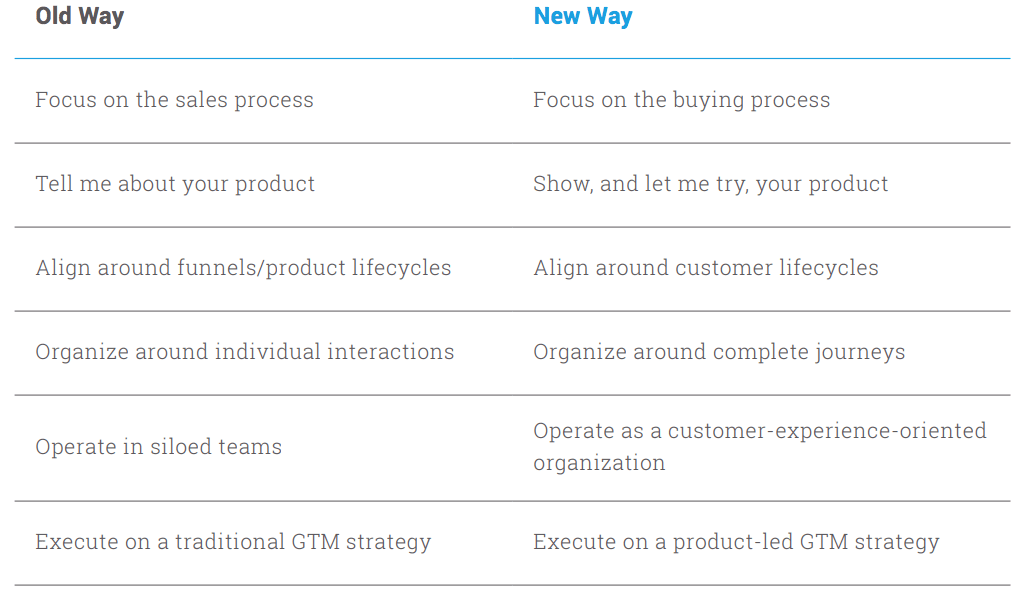
First, let’s see how the customer acquisition process is changing.
Before the SaaS revolution, enterprise software companies were predominantly sales-driven, with the company speaking at length with a sales rep to get product information. The high-touch sales model was warranted, since customers were required to sign long-term, expensive contracts.
The subscription economy — with lower prices, ownership, and switching costs — has changed the customer acquisition model. Companies made educational and product-related content more accessible to prospective customers as they searched for more efficient ways to generate product awareness and demand. Prospects could then find, learn, and compare software products earlier in the buying process, way before they interacted with sales. In this way, content marketing and lead generation were established as primary strategies for companies to generate awareness and demand.
The rise of content marketing and lead nurturing brought us marketing automation solutions that promised, among other things, to calculate content marketing ROI. (Lead nurturing is a process of continual communication with a prospect until he or she is ready to buy.) The new marketing-led approach to customer acquisition promises to close the gap between marketing and sales. Marketing teams generate and nurture leads, while sales teams focus on prospects that are aware of a product and the problem it solves. A marketing-led approach has made SaaS companies far more efficient and effective. Eloqua, Marketo, and Hubspot are the most well-known examples of marketing automation companies that popularized a marketing-led strategy. When it comes to content marketing, Hubspot and Marketo set the standard. The amount of content created by these companies is startling.
Today, prospective customers progress far along the buying process before talking to sales, making content strategy a given. Content marketing helps prospects recognize the problem and need for the product while empowering them to evaluate alternatives and create a shortlist of potential solutions. Through content, buyers in the enterprise software market become more knowledgeable about industry products and trends. By the time your sales team interacts with a prospect, you can expect the prospect to have formed a perception of what your product does and available alternatives.
As business buyers, we often reach out to our professional and social networks for advice, or to simply ask for product recommendations. We read thought leadership content to learn about new ideas, expertise, and trends that are relevant for our decision-making. When we land on the website, we often are forced to share our contact information through lead forms in exchange for content, and then receive marketing e-mails notifying us about a new whitepaper, report, or webinar. As we come back and engage on a company’s website or through e-mail, we receive calls from a sales development team whose job is to assess our level of pain and fit — and only then are we given access to a free trial, or guided through a proof-of-concept process. This is what we refer to as the traditional acquisition process.
Figure 3.1 shows a simplified version of the traditional customer acquisition process for SaaS companies as described. This is not a universal process, since not every company gates its free trial, and not every company provides one. Furthermore, there is a whole journey that companies have to design after a prospect becomes a customer. Nonetheless, one thing should be clear: a large part of the customer acquisition journey in the traditional customer acquisition process happens outside of the product.
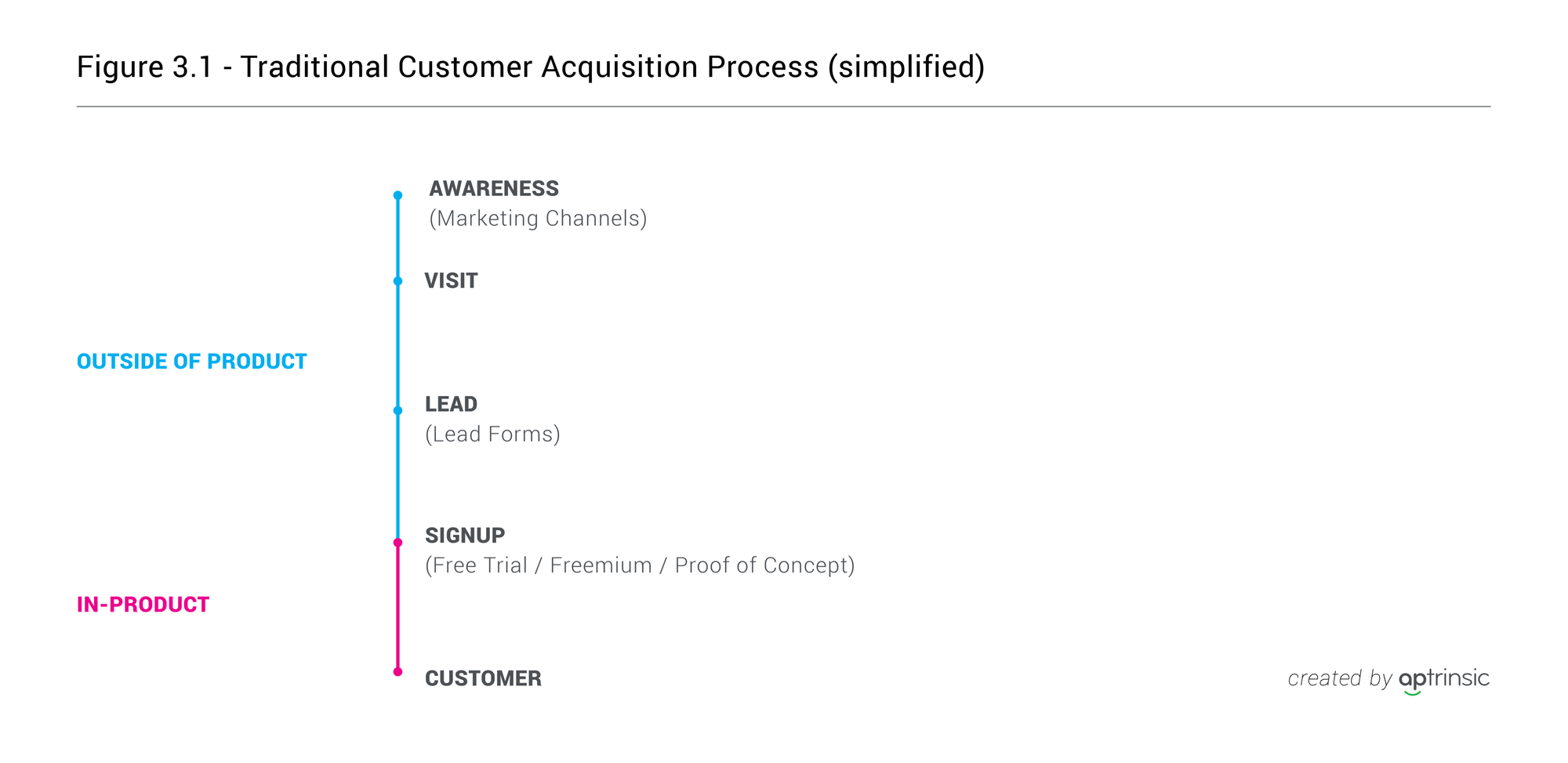
Why isn’t this approach very effective? Prospects are forced to fill out lead forms in exchange for content, or submit requests for a demo, and talk to a sales rep before accessing a free trial. In the consumer industry, the buying process rarely involves interaction with a company representative, and often just includes a self-service option. Enterprise buyers want the same frictionless experience in their professional lives. As a result, they are no longer willing to wait and jump through lead forms to try your software; they can — and will — turn around and try a competitor’s trial instead.
And how can you blame them? Who wants to receive e-mails about your next webinar, or from your sales development rep asking for a quick chat to learn whether the solution is a good fit for you?
Another key reason why the traditional customer acquisition process isn’t effective: It focuses more on the behavior of prospective customers outside of the product, rather than on in-product behavior. Think about the correlation between downloading a whitepaper, opening an e-mail or visiting a website, and the buyer’s intention to purchase a product. Lead scoring in enterprise marketing was created to show that the leads they pass to sales are of a high quality. But can you truly say with much certainty that these buyer activities strongly indicate an intent to purchase?
Let’s look at this process through the example of a consumer walking into a shoe store. Imagine that you have to talk to a sales clerk in front of the store and share your e-mail and other contact information just to walk in. Would you consider this a good customer experience? Additionally, who do you think shows a higher buying intent: someone who just walks around the store, or someone who stops to feel an Asics shoe or who asks to try a pair on?
SaaS companies that want to deliver great customer experience should pay close attention to these scenarios. In the SaaS world, a stellar customer experience depends on how well companies understand their behaviors in the product. Organizations that make it hard to evaluate and try their product irritate prospective customers with a subpar experience. Perhaps even worse, they limit their growth potential because they lose the opportunity to learn early on how customers interact with their product.